Experiments
Explore fundamental physics experiments recreated with interactive and animated interfaces.
Explore slow, elegant visual guides to classic experiments and instruments — from Ohm’s Law to ancient yantras and precision measuring tools. Use the buttons to jump directly into Experiments or Instruments.
Explore fundamental physics experiments recreated with interactive and animated interfaces.
Attributed to Aryabhata, the renowned Indian mathematician and astronomer (5th century CE). Name derived from Sanskrit: “Yasti” = stick/rod, “Yantra” = instrument/device.
A simple vertical stick fixed on a horizontal base. Functions on the principle of a gnomon (shadow-measuring device).
Measures the Sun’s shadow length and angle. Used to determine time of day, latitude, and Sun’s declination.
Calendar-making and predicting solstices and equinoxes. Agricultural planning based on seasonal cycles. Religious rituals dependent on precise timekeeping.
Laid the foundation for Indian trigonometry and spherical astronomy. Provided observational data for Aryabhata’s astronomical tables. Influenced timekeeping methods in India for centuries.
Inspired later instruments like Jantar Mantar. Marked a shift toward systematic scientific measurement. Symbol of ancient India’s mathematical ingenuity.
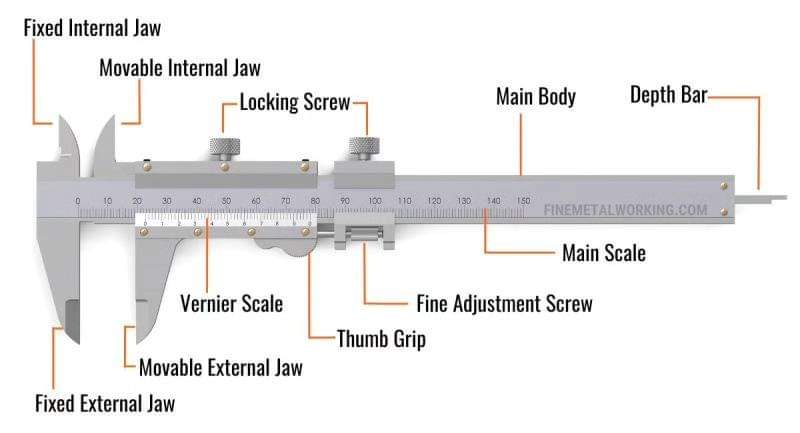
Invented by French mathematician Pierre Vernier in 1631. Created to record precise data with accuracy up to 0.01 cm. Originally developed for angle-measuring instruments before adaptation as handheld calipers.
Main Scale, Vernier Scale, Outer Jaws (external measurements), Inner Jaws (internal), Depth Rod, Retainer/Locking Screw, Fine Adjustment.
(Tutorial link) — A recommended video: YouTube: Vernier Caliper tutorial
Invented by William Gascoigne (1638); precision up to 0.001 cm. James Watt and later inventors improved compact forms; Jean Laurent's 1848 patent shaped modern designs.
Frame (C-shaped), Anvil, Spindle, Precision Screw & Nut, Sleeve/Barrel, Thimble, Locknut, Ratchet stop for consistent pressure.
(Tutorial link) — Try: YouTube: Micrometer tutorial
Dhanur Yantra is a sacred geometric design inspired by the shape of a bow. It symbolizes focus, discipline, and inner strength — the still, drawn moment before action.
Originated in medieval India as both a spiritual and scientific tool. Used in ancient Indian astronomy to measure celestial altitudes and determine seasons; aligned toward true south when used for observation.
Graceful bow-like curves, a central bindu (focus), arrow-like elements representing clarity, symmetry reflecting balance between movement & stillness. Associated with divine archers like Lord Rama and Shiva.
Meditation, tantric focus practices, honored during Dhanurmasa (mid-Dec to mid-Jan), and used in temple art and crafts.